
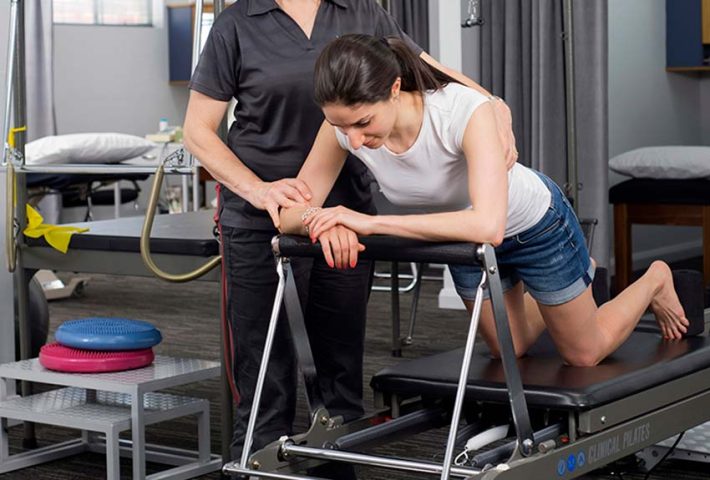
The reformer looks like an odd piece of furniture. A low padded carriage, a set of springs, a footbar, a couple of straps. People walk past one in a gym and assume it’s for stretching, or for people who are already fit. Most have no idea the same machine sits in physiotherapy clinics, used for something much closer to rehabilitation than to a workout.
That gap, between the Pilates you see advertised and the kind a physiotherapist runs, is the whole story.
Same name, very different intent
A studio class teaches a method to a room full of people. The instructor counts reps, fixes the obvious things, keeps everyone moving. It’s good exercise. For plenty of people it’s all they need.
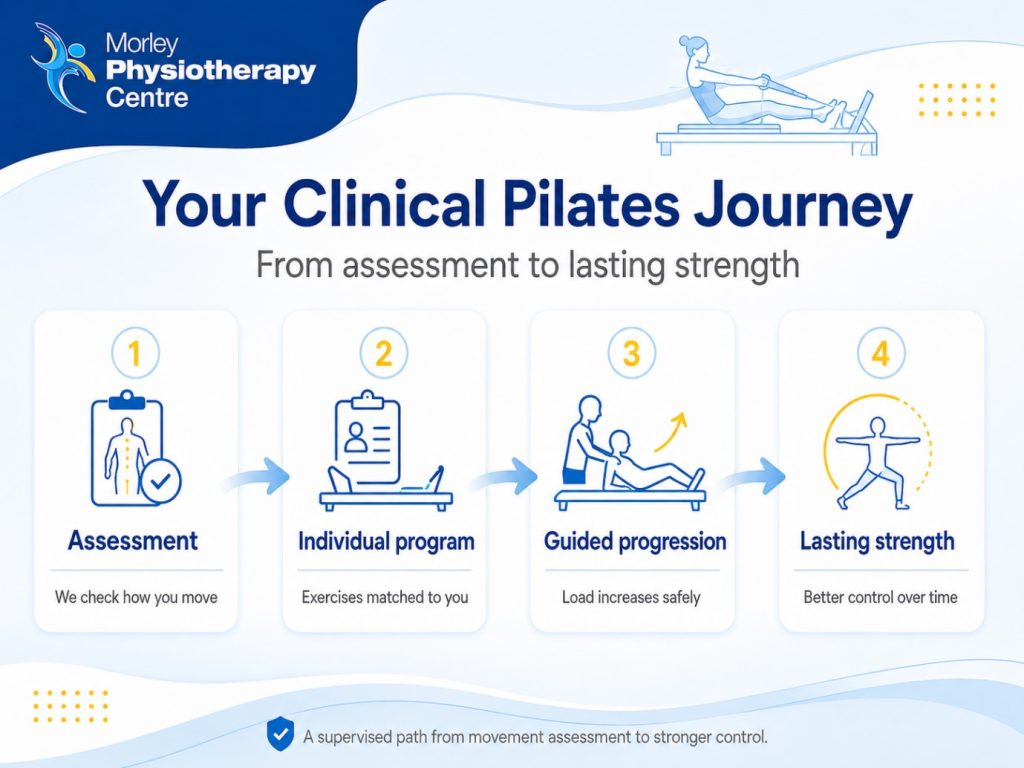
Clinical Pilates works the other way round. Before anyone touches a reformer, there’s an assessment. A physiotherapist looks at how you move, where you’re weak, what hurts and why. Only then do the exercises get chosen. Same equipment, sometimes the same movements, but the reason behind each one is specific to you rather than to the room.
The clinic’s own line on this is blunt: a physio is trained to understand a person’s pathology and how it behaves. A gym instructor, however good, usually isn’t.
It starts with a problem, not a class
Book in for physio in Morley and your first Pilates session won’t involve much Pilates at all. It’s musculoskeletal physiotherapy first. The therapist maps the weak links, the old injuries, the joints that have stopped moving the way they should.
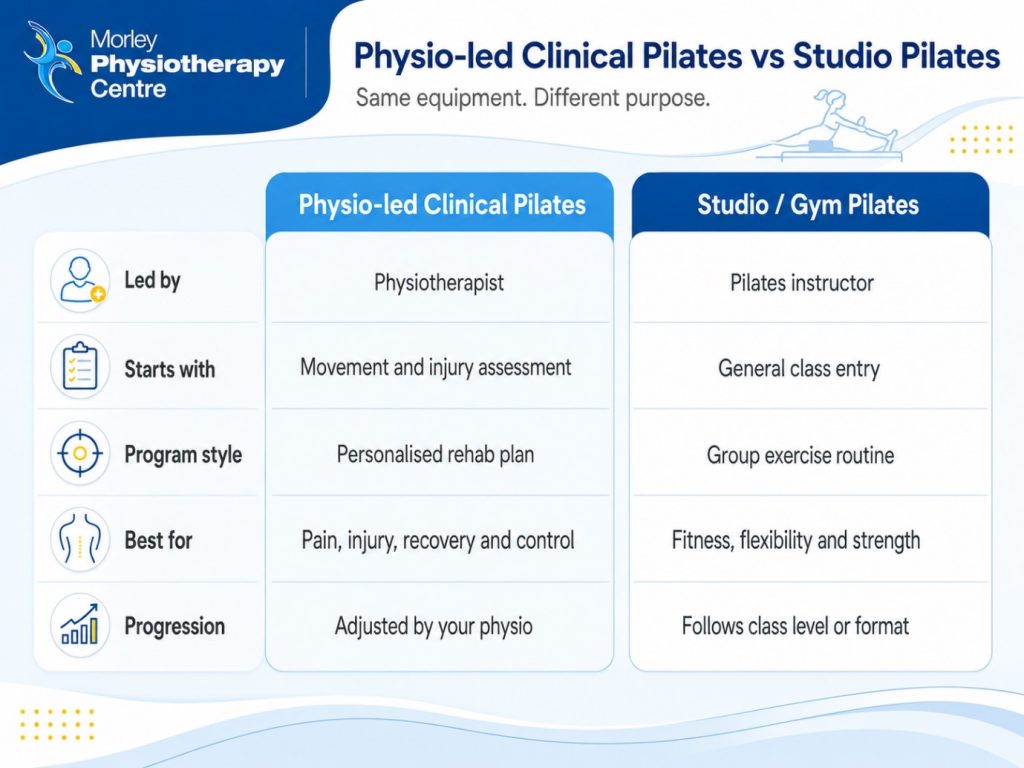
What comes out of that isn’t a generic routine. It’s a program built around your specific weaknesses and adjusted as you get stronger. If your left hip won’t stabilise, that gets targeted. If an old back pain flare keeps returning, the program is loaded carefully around it instead of hoping it holds. Often the Pilates runs alongside regular physiotherapy and hands-on treatment rather than replacing it, so the reformer work and the manual therapy pull in the same direction.
The machines do the careful work
Two pieces of equipment carry most of Clinical Pilates in Morley: the reformer and the trap table. Both run on springs, which sounds basic until you see what springs let a therapist do. Resistance shifts up or down by tiny amounts. The very same exercise can be made gentle enough for someone two weeks out of surgery, or hard enough to test an athlete.
That range is the point. Rehab needs load you can control to the notch, not a fixed weight that’s either too much or nothing at all. Springs give a physiotherapist that control, position by position.
Who actually benefits
The people who get the most from it are rarely the ones you’d picture. Post-surgical patients rebuilding strength under supervision. Office workers whose necks and lower backs have quietly seized up over years at a desk. Runners with a niggle that keeps coming back. Anyone who’s lost the deep stabilising strength that holds joints in good positions while the body does everything else.
What ties them together isn’t fitness level. It’s a missing piece of control somewhere in the chain, a joint that gives a little when it should stay steady. A reformer is one of the few places that gap can be trained slowly, with a therapist adding load only once the body has earned it.
Lower back pain is the clearest case. The science here is still building rather than settled, but recent research points to emerging support for Pilates improving core strength and easing chronic low back pain, at least in the shorter term. For a condition that catches most people at some stage of life and has a habit of returning, a supervised, progressive program is a sensible starting point rather than a last resort.
Why local and supervised makes the difference
A program you can’t easily get to is a program you won’t finish. That’s the quiet advantage of doing this close to home with the same team each visit. They watch your form, catch the moment something slips, and adjust before a small compensation grows into a fresh problem. Turning a handful of sessions into strength that lasts comes down to that kind of continuity.
It helps, too, that the person guiding your reformer work already knows your history. They assessed you. They know which movements to push and which to hold back this week. A drop-in class, however well run, can’t really offer that.
If a niggle keeps returning, or you simply want to build real core strength under proper supervision, the team at Morley Physiotherapy Centre is here to help. Get in touch to book a consult with one of our Clinical Pilates-trained physiotherapists, or call us on 9375 3900 and we’ll talk through whether it’s the right fit for you.