
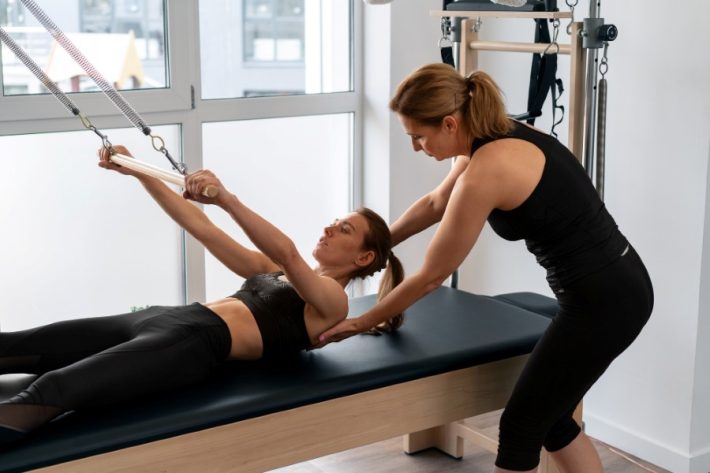
Clinical Pilates and group reformer classes may use similar equipment, but they are designed for different needs. Clinical Pilates may be a better starting point when pain, injury or a health condition makes a standard exercise program difficult to follow. A group reformer class may be suitable when you can exercise comfortably, follow general instructions, and do not require individual clinical management.
The main difference is not the reformer machine. It is the way your exercises are assessed, selected and progressed.
Clinical Pilates programs usually begin with a thorough musculoskeletal assessment. This allows your physiotherapist to consider your symptoms, movement, medical history and personal goals before developing your exercise program.
What is the difference between Clinical Pilates and Group Reformer Pilates?
Both Clinical Pilates and group reformer classes may use spring-loaded reformer equipment. However, they usually have different purposes.
A group reformer class generally follows a planned sequence for several participants. The instructor may provide alternative exercises, but the overall program is designed for the group.
Physiotherapist-led Clinical Pilates is individually programmed following an assessment. Resistance, range of movement, repetitions and exercise positions can be adjusted according to your current ability and symptoms.
Clinical Pilates is not automatically the best choice for everyone. Many people participate successfully in group reformer classes. The decision depends on whether you need general exercise or a more individual rehabilitation approach.
1. Choose Clinical Pilates when pain affects how you move
Persistent back, shoulder, hip, or knee pain can make it difficult to know which exercises are suitable.
You may avoid certain movements because you are worried about causing further damage. Alternatively, you may continue pushing through exercises that repeatedly aggravate your symptoms.
A physiotherapist can assess possible contributors to your pain and determine which movements you currently tolerate. Your program can then begin at an appropriate level and progress as your confidence and capacity improve.
People managing ongoing symptoms may benefit from Clinical Pilates for persistent lower-back pain when a standard class does not provide enough individual modification.
Healthdirect advises people with lower-back pain to remain active where possible but recommends consulting a doctor or physiotherapist when they are uncertain which exercises are appropriate.
2. Choose Clinical Pilates when reformer classes aggravate your symptoms
Muscular fatigue after unfamiliar exercise can be normal. Sharp, increasing or recurring pain is different and should not simply be ignored.
Symptoms may become irritated because:
- The range of movement is currently too large.
- The resistance does not match your present capacity.
- The exercise is progressed too quickly.
- Fatigue affects your control.
- A previous injury has not been fully rehabilitated.
- The available class modification is still unsuitable.
This does not necessarily mean that reformer Pilates is harmful. It may mean that the particular exercise, load or class format is not right for you at this stage.
A Clinical Pilates assessment in Morley can help identify which exercises can be continued, which need adjustment, and how you may return to general classes safely.
3. Choose Clinical Pilates after an injury or operation
Following an injury or operation, the body may not be ready to return immediately to unrestricted group exercise.
Your program may need to account for healing time, movement restrictions, pain levels, strength deficits and advice from your surgeon or treating practitioner. Clinical Pilates can provide a structured progression between early rehabilitation and normal activity.
Exercises may initially use supported positions and manageable resistance. As your function improves, the program can become more challenging and better reflect the physical demands of work, sport, or everyday life.
This guide on managing lower-back pain in netball explains how load, movement and sport-specific demands can influence back symptoms.
4. Choose Clinical Pilates when you have several health considerations
Exercise selection may require additional care when more than one factor affects your movement.
This may apply when you are managing:
- Osteoarthritis or osteoporosis
- Pregnancy-related discomfort
- Balance difficulties
- Previous spinal or joint surgery
- Several past injuries
- A neurological or long-term health condition
These conditions do not always prevent participation in group exercise. However, individual Clinical Pilates for injury rehabilitation may provide a more appropriate introduction when your exercises require closer adjustment or monitoring.
5. Choose Clinical Pilates when you cannot keep up comfortably
You do not need to be strong, flexible, or experienced before starting Pilates.
However, a faster group environment can feel difficult when you need more time to understand an exercise, change position or adjust the equipment. Clinical Pilates allows exercises to be taught and progressed according to your individual starting point.
The aim is not to keep you in supervised rehabilitation forever. Your physiotherapist may help you build the strength, movement control and confidence needed to progress into a suitable group class, gym program or independent exercise routine.
When is a group reformer class appropriate?
A group reformer class may be a reasonable choice when:
- Your main goal is general exercise and fitness.
- You can complete the class without worsening symptoms.
- You can follow the program and use the available modifications.
- You understand the class level and equipment.
- You do not require condition-specific clinical supervision.
Pilates can be one useful form of exercise for people with lower-back pain, but no single type of exercise is suitable for every person. The most useful program is generally one you can perform consistently, confidently, and without repeated symptom aggravation.
What happens during a Clinical Pilates assessment?
Before starting Clinical Pilates at Morley Physiotherapy, your physiotherapist will discuss your symptoms, health history, and goals.
Relevant movement, strength, and function may then be assessed. Your physiotherapist can use these findings to select exercises and adjust the reformer springs, movement range, position, and repetitions.
Your program can be reviewed as your symptoms and ability change. This individual approach is particularly valuable when the purpose of Pilates is rehabilitation rather than general fitness.
Which option should you choose?
Consider Clinical Pilates first when pain is persistent, an injury is still affecting your movement, standard classes repeatedly aggravate symptoms, or you need condition-specific modifications.
A group reformer class may suit you when you can comfortably participate in general programming and your primary goal is regular exercise.
Still uncertain? Contact Morley Physiotherapy Centre to discuss the most appropriate starting point.
Frequently asked questions
Is Clinical Pilates safer than group reformer Pilates?
Clinical Pilates is not automatically safer for every participant. Its main advantage is that exercises can be selected following an individual assessment. This may be helpful when pain, injury or a medical condition affects your exercise choices.
Do I need Clinical Pilates for lower-back pain?
Not everyone with lower-back pain requires Clinical Pilates. Consider an assessment when pain persists, repeatedly worsens during classes, affects daily activity or makes you uncertain about which exercises are suitable.
Is Clinical Pilates performed on a reformer?
Clinical Pilates may include reformer exercises, mat exercises and other equipment. The term refers to the clinically assessed, individually programmed approach rather than one particular machine.
Can I return to group reformer after Clinical Pilates?
Yes. Clinical Pilates may help prepare you to return to a suitable group class by gradually improving strength, movement tolerance and confidence.
Do I need a referral for Clinical Pilates?
A referral is generally not required to see a private physiotherapist in Australia. Referral and funding requirements may differ for Medicare programs, workers’ compensation, motor vehicle claims or other third-party arrangements. Contact the clinic before booking when a claim or care plan is involved.