
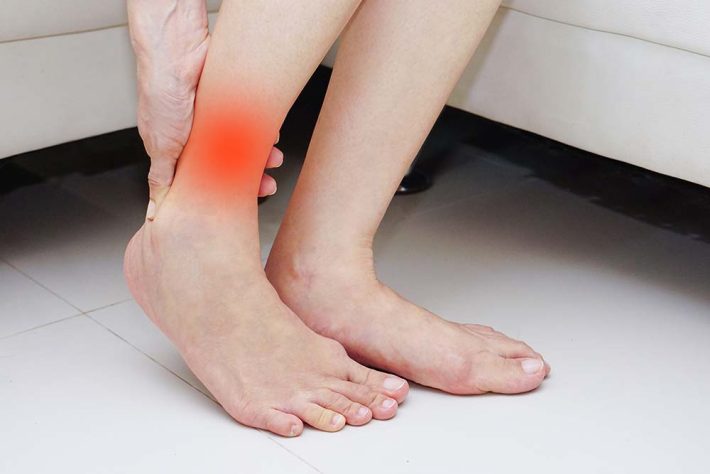
Achilles tendon pain can make stopping exercise feel like the safest option. A few days of reduced activity may settle an irritated tendon, but prolonged complete rest often leaves the calf and Achilles less prepared for the demands that caused the problem.
For people with midportion Achilles tendinopathy, rehabilitation usually involves managing load rather than removing it altogether. The aim is to find a level of activity the tendon can tolerate, then build strength and capacity gradually.
What Achilles tendinopathy feels like
The Achilles tendon connects the calf muscles to the heel bone. It works hard during walking, running, jumping and any movement that involves pushing through the foot.
Midportion Achilles tendinopathy commonly causes pain or stiffness a few centimetres above the heel. Morning stiffness is common. Some people notice pain during their first few steps after sitting, while others feel discomfort when they start running that changes as they warm up.
Symptoms often appear after a change in load. That might be an increase in running distance, more hill work, a return to sport after a break, or a sudden rise in training frequency.
Persistent Achilles tendon pain should be assessed when it is affecting walking, exercise, work or sport, especially when symptoms are worsening or the diagnosis is uncertain.
Why complete rest may slow recovery
Rest can reduce symptoms because the tendon is exposed to less force. The difficulty comes when rest is the only strategy.
Tendons adapt to load. When loading drops for an extended period, the calf and Achilles complex may lose some of its ability to tolerate the forces required for running, jumping or prolonged walking.
This can create a familiar pattern. The tendon feels better after several weeks away from activity, so the person returns to their previous training level. Pain then returns because the tendon has not yet rebuilt enough capacity for that workload.
Current clinical guidance for midportion Achilles tendinopathy recommends tendon-loading exercise as first-line treatment and advises that complete rest is not indicated, with activity continued within pain tolerance.
That does not mean continuing every activity unchanged. An irritated tendon often needs a temporary reduction in the loads that provoke symptoms most strongly.
Adjusting activity without stopping everything
Relative rest may involve changing how much, how often or how intensely you exercise.
A runner might reduce distance, remove hill sessions or pause speed work for a period. Someone involved in court sports may need to reduce repeated jumping and rapid changes of direction while maintaining other forms of conditioning.
The response over the following hours is useful. If pain and stiffness increase noticeably after a session or are clearly worse the next morning, the tendon may have been exposed to more load than it currently tolerates.
Mild discomfort during rehabilitation does not automatically indicate further tendon damage. Persistent increases in pain, loss of function or a steady worsening of symptoms are reasons to modify the program and seek assessment.
Rebuilding tendon capacity with exercise
Progressive loading is commonly used to restore strength and increase the amount of force the Achilles tendon can handle.
Rehabilitation may begin with controlled calf-loading exercises. Resistance can then increase as strength and tolerance improve. People returning to running or sport may later need faster calf work, hopping, running drills and other tasks that better resemble the demands of their activity.
The exercise program should reflect what the person needs to return to. Someone who wants to walk comfortably has different requirements from a footballer, runner or netball player.
Sports injury physiotherapy can help establish a suitable starting point and identify whether calf weakness, reduced ankle function or recent training changes are contributing to the problem.
Progress also needs to be gradual. An exercise that was challenging early in rehabilitation may eventually become too easy to produce further adaptation. Increasing resistance or task difficulty can help prepare the tendon for higher demands without making large jumps in workload.
When Achilles pain needs prompt assessment
Not every painful Achilles tendon is tendinopathy.
A sudden sharp pain or a popping sensation at the back of the ankle, particularly when followed by difficulty walking or pushing through the foot, may indicate a rupture. That requires prompt medical assessment.
Pain at the point where the tendon attaches to the heel can also behave differently from midportion Achilles tendinopathy. Exercise choices sometimes need to be adjusted according to the location and nature of the symptoms.
Worsening swelling, increasing weakness, persistent pain or symptoms that do not improve despite sensible load changes are also reasons to have the area assessed.
Physiotherapy for Achilles tendon pain
At Morley Physiotherapy Centre, we provide physiotherapy in Morley for musculoskeletal and sports-related conditions, including ankle and Achilles problems.
Assessment can help establish which activities are aggravating the tendon, how much load it currently tolerates and whether strength or movement has changed. Rehabilitation can then be progressed towards the demands of walking, work, running or sport.
Frequently Asked Questions
Should I stop walking if I have Achilles tendinopathy?
Not necessarily. Many people can continue walking if symptoms remain manageable and do not worsen significantly afterwards. If normal walking causes increasing pain, limping or a clear rise in symptoms the next morning, the amount of activity may need to be reduced and assessed.
Can I still run with Achilles tendinopathy?
Some people can continue modified running while recovering, while others need a temporary break from running. Distance, pace, hills and frequency can all affect tendon load. The decision should be based on symptom behaviour, current strength and how the tendon responds after each session.
How long does Achilles tendinopathy take to recover?
Recovery time varies. Mild, recently developed symptoms may settle more quickly than long-standing tendinopathy. Rehabilitation usually requires progressive loading over time rather than a few days of rest. Training demands, tendon capacity and consistency with rehabilitation can all affect the timeline.
Are calf raises good for Achilles tendinopathy?
Calf-loading exercises are commonly used in Achilles rehabilitation, but the appropriate exercise and resistance depend on the person and the type of Achilles problem. Progression is usually needed as strength improves. A generic calf-raise program may not suit every stage of recovery.
When should I see a physio for Achilles pain?
Consider an assessment if pain is persistent, repeatedly returns when activity increases, affects walking or sport, or is associated with weakness or swelling. Sudden pain with a pop or major loss of push-off strength should be assessed promptly because an Achilles rupture needs different management.